
For more than a thousand years, Damascus steel has been the name attached to the most beautiful and most mysterious blades ever forged. The original Damascus — the “wootz” swords that cut silk in mid-air and kept their edge through entire crusades — was lost to history around 1750. Modern metallurgy can produce something that looks like Damascus, but what the original masters actually did with iron sand, carbon, and luck has never been fully recreated. This guide separates the legend from the metallurgy, explains how modern Damascus is made, and shows you how to buy a genuine pattern-welded blade today.
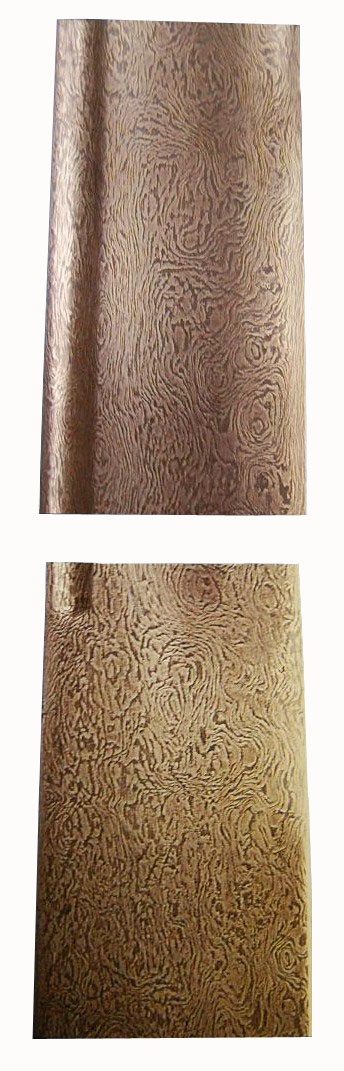
What Is Damascus Steel, Really?
There are two very different things called “Damascus steel” today:
- Wootz (original Damascus). A crucible steel produced in southern India and Sri Lanka from the 3rd century BCE to roughly 1750 CE. It was traded in ingots, forged in the Middle East — especially in Damascus, which gave it its European name — and its natural “watered” pattern came from the internal crystal structure of the steel itself. No modern smith has convincingly reproduced true wootz.
- Pattern-welded “Damascus” (modern). Two or more steels of different carbon or nickel content, forge-welded together, folded repeatedly, and then acid-etched to reveal the contrasting layers. Almost every “Damascus” knife or sword sold today is pattern-welded.
The Wikipedia entry on Damascus steel is careful to note that the two are metallurgically different — but visually, a high-quality pattern-welded modern blade looks nearly identical to a historical wootz blade.
The Ancient Wootz Mystery
The performance of authentic wootz blades was so extraordinary that European crusaders brought home legends that lasted centuries. Crusader accounts describe wootz scimitars shearing through mail armor, splitting a silk scarf falling edge-first, and retaining their edge through long campaigns. Modern electron-microscope analysis of surviving wootz blades — notably by Professor John Verhoeven and bladesmith Alfred Pendray — has revealed that the steel contains carbon nanotubes and cementite nanowires.
Yes, really. Tiny structures that modern materials scientists only described in the 1990s were being produced by illiterate smiths in 10th-century India through a combination of specific ore impurities, slow crucible cooling, and repeated forging. When the ore sources were depleted around 1750, the method was lost with them. Reproducing wootz today requires not just the technique but also the precise impurity profile — vanadium, molybdenum, and trace rare earths — of the original Indian ores.
How Modern “Damascus” Is Made
Modern Damascus is always pattern-welded. The process:
- Stacking. Alternating layers of two steels — typically a high-carbon and a low-carbon, or a high-nickel and a low-nickel — are stacked into a billet.
- Forge-welding. The billet is heated and hammer-welded into one solid piece.
- Folding. The billet is drawn out, cut, stacked again, and forge-welded again. Each fold doubles the layer count. After 10 folds: 1024 layers. After 13 folds: 8192 layers.
- Shaping. The billet is forged into the blade’s final profile.
- Heat treatment. For katanas, differential clay tempering — producing the hamon — goes here.
- Etching. After polishing, the blade is dipped in acid (typically ferric chloride). One of the two steels etches darker than the other, revealing the layered pattern.
The traditional Japanese sword-making process (see full breakdown) has always included folding. Japanese smiths call the result jihada — the “ground pattern” — not Damascus, but the metallurgy is closely related.
Common Damascus Patterns
The pattern you see on a Damascus blade depends on how the billet was folded and manipulated:
- Random Damascus — basic folded pattern, no manipulation. Flowing and organic.
- Twist Damascus — the billet is twisted like taffy before forging flat. Produces tight spiral patterns.
- Ladder Damascus — grooves are cut laterally across the billet; re-forged flat, they appear as rungs of a ladder.
- Raindrop Damascus — indentations dimpled into the billet before final forging. Each dimple becomes a raindrop-shaped ring.
- Feather Damascus — two twisted billets forge-welded together; the resulting pattern resembles a feather shaft with barbs.
- Mosaic Damascus — different billets combined geometrically to create figurative imagery.
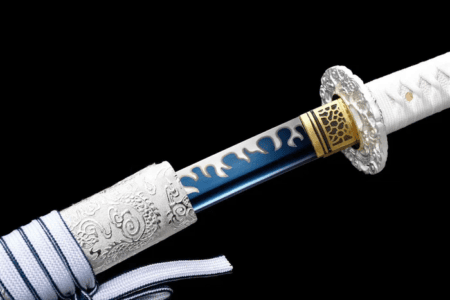
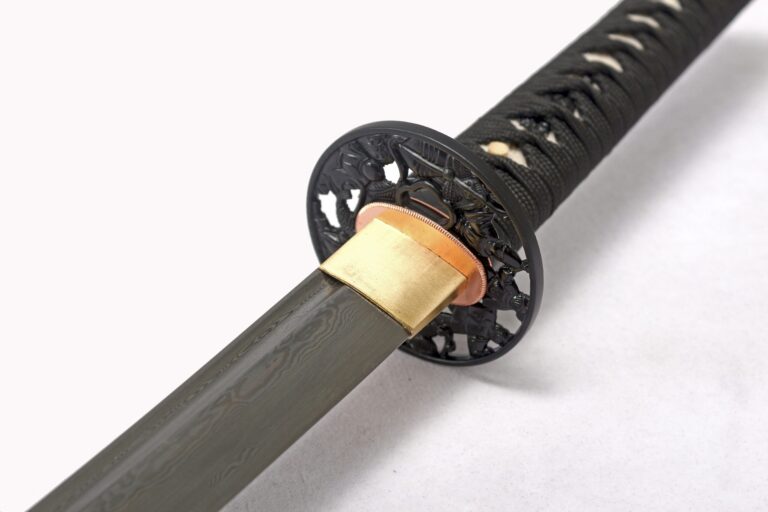
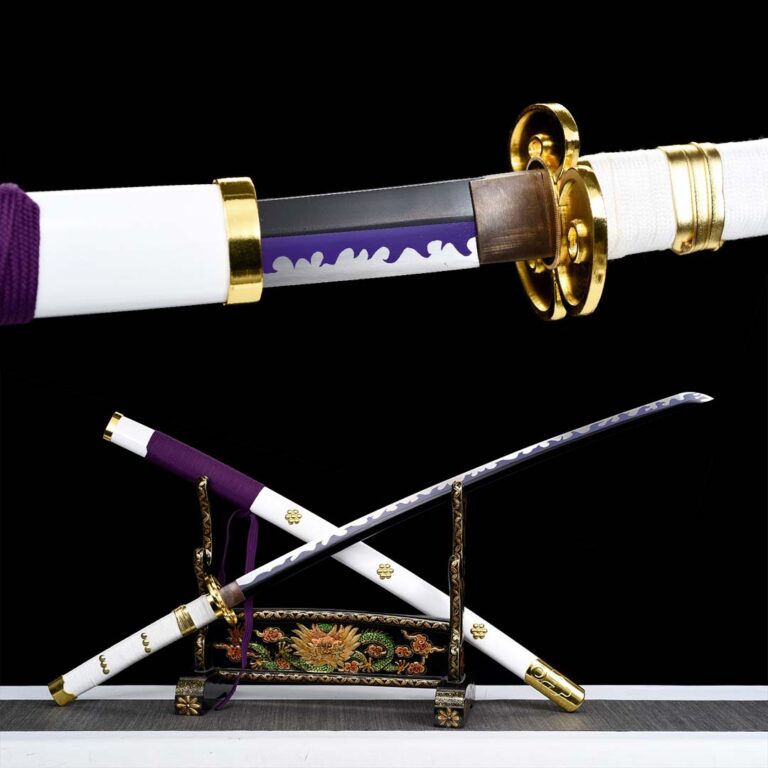
⚔ Featured Katana Picks
Handpicked from the Katana Heaven Collection
Is Damascus Steel Actually Better Than Regular Steel?
The honest answer: for modern pattern-welded Damascus, usually no — performance-wise. A properly heat-treated monosteel blade (T10, 1095, or a modern alloy) matches or exceeds pattern-welded Damascus in edge retention, flexibility, and impact resistance. The value of modern Damascus is aesthetic, historical, and prestige-based.
For original wootz, the answer flips: wootz blades outperformed the monosteels of their era by a significant margin — that is how they earned their reputation. But modern steel technology surpassed wootz’s peak performance in the late 19th century. Today, wootz is valuable as craft, not as a functional standard.
How to Tell Real Damascus from Etched Fake
Cheap blades are sometimes sold as “Damascus” when they are actually monosteel with a laser-etched or print-stamped pattern on the surface. The difference is easy to spot once you know what to look for:
- Edge test. Real Damascus continues its layered pattern all the way to the cutting edge. Fake Damascus ends at the edge bevel.
- Spine test. On a genuine pattern-welded blade, the pattern also extends across the spine. Fake Damascus has a clean monosteel spine.
- Re-polish test. If you lightly polish the surface of fake Damascus, the pattern disappears. On real Damascus, polishing and re-etching restores the pattern.
- Depth. Real Damascus layers are visible at multiple angles of light; fakes look flat.
Why Wootz Has Never Been Fully Recreated
Several teams have produced “wootz-like” steel in laboratories since the 1990s, including Verhoeven and Pendray’s famous work at Iowa State. But three factors have kept the full reproduction elusive:
- Ore depletion. The specific Indian and Sri Lankan iron deposits that produced wootz’s characteristic trace elements were mined out by 1800.
- Process secrecy. The ancient crucible steel-makers worked in guilds that never wrote their methods down. When those guilds ended, the exact thermal cycle ended with them.
- Random variables. Wootz’s nanowire and nanotube structures depended on specific cooling rates, furnace atmospheres, and forging temperatures that varied blade by blade — many historical wootz blades were mediocre. Only a fraction of ancient wootz reached the performance modern accounts describe.
Frequently Asked Questions About Damascus Steel
Why is it called “Damascus” if it comes from India?
The raw wootz ingots were shipped from India to the Middle East, where smiths in and around Damascus forged them into blades. European traders bought them in Damascus markets, so they named the steel for the city — not for the origin.
Is Japanese folded steel the same as Damascus?
Metallurgically similar — both are folded laminated steels. But Japanese tamahagane and the Indian wootz are produced from different ores by different processes, and the Japanese jihada pattern is finer and more uniform than classic Damascus.
Can a Damascus katana be battle-ready?
Yes, if it is pattern-welded with two high-quality steels and properly heat-treated. Our Katana Tamba and the rest of our Damascus catalog are battle-ready and clay-tempered for the genuine hamon as well.
Continue with our complete guide to real katana steels for the deeper context on tamahagane, T10, 1095, and folded steels.