
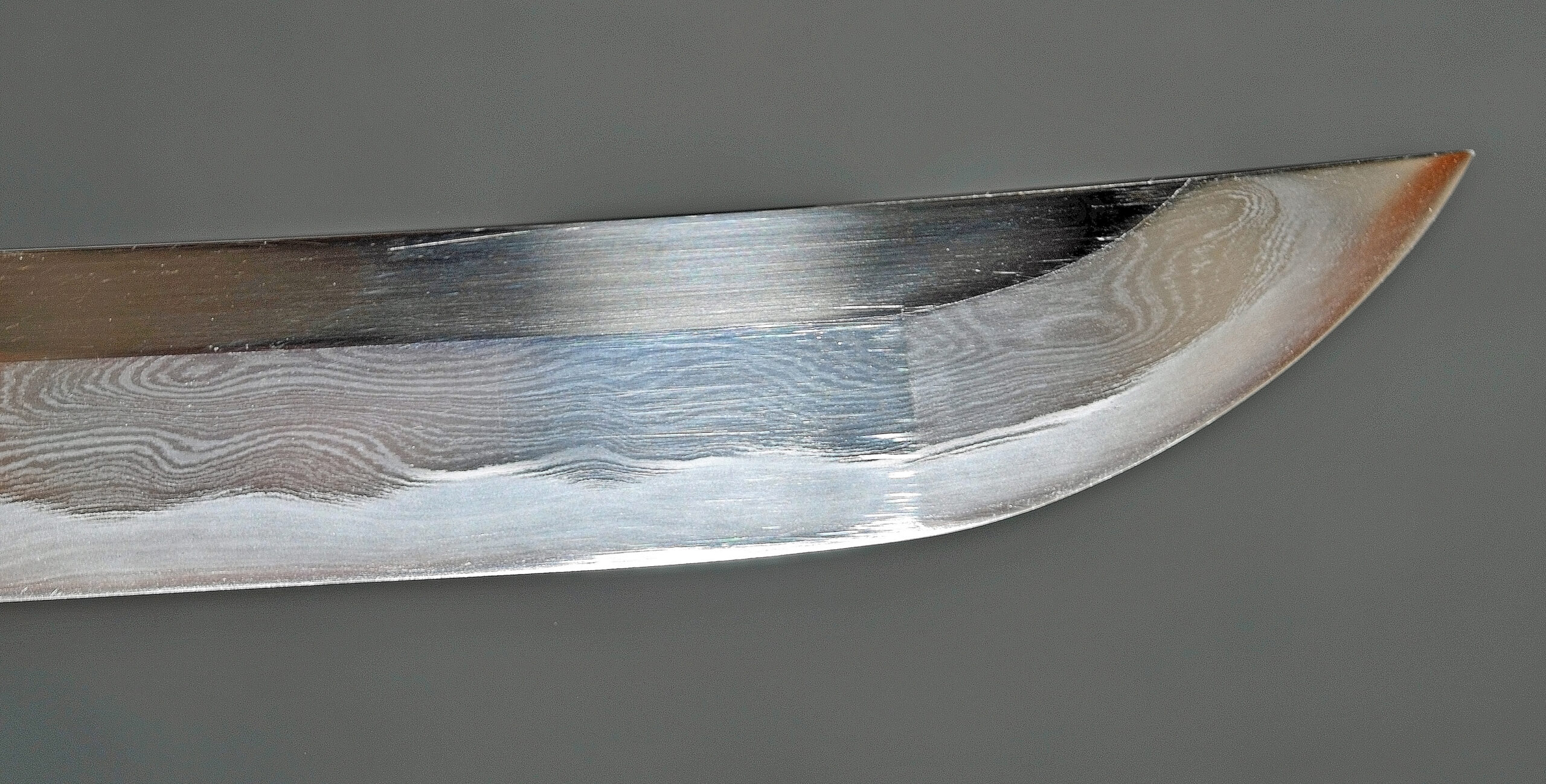
Every section of a Japanese blade has a story — but one small zone tells the clearest story of all. The boshi, the portion of the hamon that curves inside the kissaki, is the single most revealing element of a katana. Appraisers read it first. Master polishers agonize over it. And the difference between a masterpiece and a mid-grade blade is almost always visible at the boshi before it is visible anywhere else. This guide explains exactly what the boshi is, how it is formed, how to read the major styles like a collector, and why the boshi decides a sword’s true mastery.
What Is the Boshi?
The bōshi (帽子, literally “hat” or “cap”) is the hamon inside the kissaki — that is, the temper line as it curves past the yokote and wraps around the tip of the blade. It is a direct continuation of the hamon running up the rest of the edge, but every separately-forged section of Japanese blade treats the boshi as its own project. A blade’s boshi is cut by the same clay tempering process that creates the hamon; see our hamon reading guide for the underlying metallurgy.
The boshi matters so much because the kissaki is the part of the blade that does the most work in a real cut: it lands first in a descending strike, it redirects the opponent’s edge in a bind, and it concentrates the force of every thrust. If the boshi’s hardening is uncontrolled, the tip becomes brittle and chips. If the boshi is missing entirely — as happens on some mass-produced blades with an acid-etched fake hamon — the tip is structurally weak no matter what the rest of the edge looks like.
How the Boshi Is Formed
During yaki-ire (the clay-quench), the boshi is created by the last few centimeters of clay that the smith paints around the kissaki. Three decisions in that moment determine every boshi characteristic:
- Where the clay line turns. If the clay line curves sharply just past the yokote, the hamon “turns back” steeply into the tip.
- How thick the clay is at the very point. A thicker daub at the tip leaves a softer kissaki; a thinner daub hardens it through.
- Whether the clay line closes back on itself. A closed boshi returns to the mune before the tip; an open boshi runs off the edge of the blade.
These three decisions produce every named boshi style in Japanese appraisal — each one the literal fingerprint of the smith’s hand.
The Classic Boshi Styles
Learning the named boshi shapes is how a nihontō student progresses from “I see a wavy line” to “I recognize this as Kamakura-period Bizen work.” The major shapes:
- Komaru — small round turnback. Clean and symmetrical; a signature of Yamashiro-school smiths.
- Ōmaru — large round turnback. Bold shape favored by Sōshū tradition smiths.
- Jizō — shaped like the silhouette of Jizō Bodhisattva’s head; typical of mid-Kamakura Bizen.
- Midare-komi — the wavy midare hamon continues into the tip; extremely common in shintō period (17th century) blades.
- Kaen — “flame.” Flamelike upward hamon tongues in the tip; Sōshū Masamune school.
- Ichimai — “one sheet.” The boshi is fully hardened across the entire kissaki, leaving no soft turnback. Structurally the strongest but aesthetically rare.
- Hakikake — “swept.” Fine nie streaks appear as though brushed across the tip.
- Notare-komi — gentle wave continuing into the kissaki.
- Tōran — large dramatic waves inside the tip; shintō Ōsaka tradition.
How to Read a Boshi Like an Expert
Reading a boshi is a five-step examination. Do these in order every time and your eye will train itself.
1. Check the Yokote Transition
Hold the blade so the yokote (the ridge separating the main edge from the kissaki) is under direct angled light. A proper boshi has an unambiguous, intentional break at the yokote — never a smeared fadeout. A smeared line means the polisher or smith had to fix a flaw.
2. Trace the Turnback (Kaeri)
The kaeri is the portion of the boshi that turns back toward the mune. Measure how far it runs. A long kaeri returns deep along the back of the kissaki; a short kaeri stops almost immediately. Both are valid, but consistency matters — compare left and right sides of the blade and confirm they match.
3. Look for Nie and Nioi Inside the Boshi
The crystalline structure inside the boshi should mirror the main hamon. Sudden changes — large nie bursts where the main hamon shows only nioi, for example — indicate the kissaki was re-polished, re-shaped, or repaired.
4. Check for Continuity
The boshi should continue the rhythm of the main hamon without interruption. Breaks or “islands” of tempered steel inside the kissaki suggest a re-hardened tip — a major appraisal flaw.
5. Compare Both Sides
A master’s blade will have boshi that mirror between left (omote) and right (ura). Asymmetric boshi is one of the fastest ways to identify a journeyman smith or a reforged tip.
⚔ Featured Katana Picks
Handpicked from the Katana Heaven Collection
-
 €255.60
 -
-
 €255.60
 -
 €296.40
Why the Boshi Is the Hardest Part of a Polish
A professional togishi (sword polisher) spends up to 30% of a complete polish time on the boshi alone — despite it being less than 5% of the blade’s surface. The reason is simple: if the boshi is polished away, it cannot be restored. A polisher who over-grinds the kissaki reveals un-hardened “dead” steel, destroying the blade’s structural and collector value. Many polishers refuse to work on older blades where the boshi is already worn dangerously thin.
The Boshi as a Measure of a Smith’s Mastery
Walk through any serious nihontō exhibition and you will see curators photograph boshi first. The reason is a practical one: a 1000-year-old blade can have a re-polished edge, a re-wrapped handle, a replaced tsuba. But the boshi shows whether the original yaki-ire was in control. When you see a confident ichimai boshi on a 14th-century Masamune, you are looking at the clearest surviving fingerprint of the smith himself. For more context, see our guide to the best blacksmiths in Japan.
Frequently Asked Questions About the Boshi
What happens if a blade has no boshi?
A blade without a boshi has a soft, un-hardened tip. It will chip easily on any impact. On antique blades, a missing boshi often means the tip was worn down or broken and replaced without a proper re-yaki-ire — a serious structural flaw.
Can I see the boshi on a modern production katana?
Yes — if the blade is clay-tempered (T10 or 1095 with genuine hamon). Mass-produced stainless katanas with acid-etched hamon typically have no real boshi, which is one of the fastest ways to identify them.
What boshi style is most prestigious?
None is universally “best.” The ichimai boshi is the rarest and hardest to produce correctly, but the komaru and jizō styles are more widely admired for their balance. What matters is consistency with the rest of the hamon and cleanliness of execution.
For the structural cousin of this article, read our hamon reading guide, or continue with every part of a katana explained.